Welcome to the Alien Country Survival Guide
In this survival guide, you’ll learn all about the movie and world of Alien Country, but also about our personal journey and creative process. We’ll share our advice on surviving as an artist and filmmaker in today’s world, what it’s like being married to your creative and business partner, and how our movie managed to survive a pandemic, foreign cyberattacks, and an apocalyptic indie film market.
You’ll also dive into the lore of Alien Country, explore a bit of UFO and ET history in America, hear firsthand accounts from our cast members who have actually communicated with extraterrestrial or supernatural beings, and pick up a few tips and tricks on how to survive an actual alien invasion.
-
This guide is more than just a fun, fast read—it’s your blueprint for hosting the ultimate Alien Country experience. At the end of each section, you’ll find interactive prompts, discussion topics, and step-by-step activities designed to immerse you and your guests in the world of Alien Country. Some activities are great for sparking late-night conversations about the unknown, while others will walk you through full-on alien communication techniques. And of course, no intergalactic gathering would be complete without themed food and drinks, so be sure to check out the recipes in the appendix. Whether you’re hosting a cosmic dinner party, a UFO-themed movie or game night, or heading out into the wild to test your survival skills for the inevitable alien invasion, this guide has you covered!
“Bring it on, Mom.” - Ben the Alien
-
There are certain moments in life that change your entire creative trajectory. For me, one of those moments was in 2013. I had set up a makeshift tent in the back of a giant convention center hall at Salt Lake City Comic Con. Amidst the ever-present echo of 100,000 sci-fi, fantasy, and pop culture fans, I found myself shaking hands with Stan Lee as he sat down for an interview.
At the time, I was newly engaged and working a full-time corporate video gig. But on the side, I was running my own YouTube channel and moonlighting as a freelance videographer for hire. Because the dream had always been the same—to craft amazing movies that captivate audiences and take them on spectacular adventures.
I had gone to film school and made dozens of short films. I had racked up millions of views on viral videos. But I had never created an original story that truly reached a large audience. On YouTube, people mostly wanted to see parodies, superhero battles, and video game adaptations. My attempts at original content just didn’t gain the same traction.
And no matter how hard I tried, I hadn’t cracked the code.
If I wanted to create something original, I needed to find the right format—something audiences were still willing to engage with… and, ideally, still willing to pay for (more on that later). For better or worse, that format was feature films.
Somewhere around 2011, two years before that Comic Con, I started writing a movie called Shotgun Jimmy. The idea was simple: What if I wrote a modern-day Western? Utah’s vast desert landscapes offered spectacular visuals, but making an actual period Western was too expensive. So, I thought—what if we swapped horses for motorcycles?
I started writing, convinced I had something solid. But looking back, the story lacked heart. It had some funny characters, a few good one-liners, but nothing that really excited me.
So I asked Stan Lee for advice.
"A lot of writers try to write for other people." he said. "I always for myself. In other words, I tried to write a story that I would enjoy reading."
At the same time, my friend Steve Olpin—whose photos you’ll see throughout this book—gave me another piece of advice. “If you want to be a fiction film director, you need to stare at yourself in the mirror for three hours asking, ‘Who am I?’”
As tongue-in-cheek as that sounded, I took the challenge seriously. What kind of movie would I actually enjoy watching? What stories did I love? Were there any common themes in the movies I was drawn to?
And that’s when I realized what my script was missing.
Monsters.
A few weeks after meeting Stan Lee, I found myself in the middle of the desert filming a short horror project with friends. We were shooting at an old, isolated gas station in the middle of the night. Before we started rolling, I wandered inside and struck up a conversation with the attendant—an older woman with chain-smoking wrinkles and eyes full of no-nonsense wisdom.
I don’t know why I asked. Maybe it was just because we were making a supernatural film. But I looked at her and said: "Have you ever seen anything weird out here?"
She leaned in, glanced toward the door, then back at me. With a raspy voice, she whispered:
"All. The. Time."
Then, for the next twenty minutes, she told me about UFOs and bizarre, unexplained things she had seen in the desert.
That was it.
That was the missing piece.
So Shotgun Jimmy, my modern-day Western, got a page-one rewrite. This time, it had aliens. And eventually a brand-new title:
Alien Country.
-
Let's Get This Party Convo Started!
Gather around, my fellow truth-seekers and skeptics! It’s time to uncover the strange and mysterious stories lurking in your own backyard. Whether you're sitting around a campfire, sharing drinks at a dinner party, or just swapping stories with friends, this first activity is sure to spark some spine-tingling conversation.
Instructions:
For best results, turn off all the lights except for one flashlight or blacklight.
Talk Local, Think Galactic: What stories of mysterious creatures or unexplained events are unique to where you live? Maybe it’s a haunted house, a particular type of cryptid sighting, or a UFO encounter—every place has its own lore. What’s yours? (If you don’t know any, take a moment to research and share your findings.)
Digging for Truth: Do you know how these legends started? Were they passed down through generations, or did someone’s uncle’s cousin’s neighbor swear it happened last year? Is there one source or many?
Truth vs. Fiction: Has anyone ever debunked or investigated these stories? Or do they remain an unsolved mystery? What do you believe? Why?
Story Swap: After years of making and taking our movie Alien Country on the road, I’ve found that about 1 in 15 people has had an encounter with "the unexplained." Take turns sharing your own bizarre tales—you might be surprised who among you has had a brush with the unknown. If no one has a real-life story—no problem! Perhaps, like us, it’s time to make one up on the spot. If there were a creature unique to your hometown or landmarks, what would it be like?
Now, dim the lights, pour yourself a drink, and let the eerie storytelling begin!
the Origins of Alien Country
-
When I meet filmmakers setting out to direct and produce their first feature, I always tell them to make a film that means something to them on a deeply personal level. And there are a couple of good reasons for that.
I grew up on the East Coast and moved to Utah for college. Between camping, canyoneering, carnivals, and demolition derbies, I experienced a wildly different culture and landscape—one that was both captivating and inspiring. As a young filmmaker, I was drawn to this world and wanted to share it with others. My love for the rugged American West, its larger-than-life characters, and its unique way of life felt deeply personal. When I set out to make my first movie, I knew I wanted to capture my perspective on my new home and country.
I was inspired by films like Hot Fuzz and Grabbers—movies that told universal stories in small-town settings. But I wanted to tell a story that was specific to my life and experience in Utah. That, I believe, is a must for first-time storytellers. Don’t just make something you love—make something that only you can make.
-
That will set your film apart. Ideally, the story I was creating was designed to have universal appeal through its characters, but the uniquely specific setting and culture would give it a feeling of authenticity. That balance of broad appeal and a unique spin, I believe, is what has given Alien Country a competitive edge as we've started to find our audience. But there’s another reason why you need to make a film that means something to you on a deeply personal level. Filmmaking is an intensely long process, and you better love the project through and through, because there will be inevitable moments, days, or even months where you are sick to death of "the same old story, the same old song and dance, my friend."
So, for what it's worth, that's my advice. Oh, and also… don’t use vintage vehicles. Especially ones that are literally designed to be destroyed in violent, adrenaline-fueled demolition arenas. (Save that for your second film. Or, you know, don’t make them a central part of the story. But hey, I did, so if you want to, I'd be a hypocrite to say you really shouldn't... so even though you really shouldn't... Whatever, YOLO, go for it!)
The point is: step into the arena and give it everything you’ve got. "You deserve to have an audience cheering for you, and even if you fall flat on your face, it's going to be great. I know it!" - Jimmy Walker
But back to the hard truth—getting a feature film off the ground takes time. So much time.
I finished the first draft of Alien Country in 2014. The next four years were a blur of pitching. Renny and I took meetings with anyone who would pick up the phone or open the door. Utah. LA. San Francisco. Anywhere someone was willing to listen. Ironically, after we made Alien Country, we would show it to film industry folks and hear them say something like: “Man, you really should have come to us earlier so we could help you package this thing and make it more commercial.”
Gee, thanks, buddy. But if you think we didn’t try to get those meetings earlier, you’re dead wrong. That’s not how the industry works. People don’t take meetings with first-time filmmakers pitching an unproven original project. So, we just had to charge ahead.
But by 2018, we were exhausted. We had hit wall after wall, and at a certain point, we had to ask: Are we actually going to make this thing, or are we going to keep waiting for permission?
Then we ran into Charan Prabhakar at an agency party in Utah.
It was one of those moments where you think you recognize someone, and they think they recognize you, so you both stand there pointing at each other, smiling, and saying "Hey… hey?"
At the time, Renny and I had just moved back from the Bay Area. Charan had played a recurring role on Silicon Valley on HBO, which was objectively cool. But that wasn’t where we knew him from. We realized we had seen each other in various YouTube videos over the years. A mutual friend had put Charan in some of his videos, and he had seen some of ours.
We started talking, hanging out, and after a few days, one thing was clear: we all wanted to make a movie.
Charan sent me a script he had written. I sent him Shotgun Jimmy. Rather than me trying to capture his excitement, I’ll let Charan tell you in his own words.
“I sent you guys a couple of my scripts, and you sent me Shotgun Jimmy. I'm telling you, I read Shotgun Jimmy, and I was laughing so hard I had to put it down. That never happens to me. I rarely have to stop reading a script because I’m so engaged and laughing that much. It was amazing. And instantly, I thought, Oh my gosh, please don’t do my script. Let’s just focus on this one.
Then we had to figure out a way to pare it down a little bit—keep the humor but trim it so we could execute it within the budget we’d be able to raise, instead of the millions of dollars it would take to make that original version of the script. But man, that first time I read it, I absolutely loved it.”
For clarity, Shotgun Jimmy was not a cheap script. It had a secret lab, government agents—the whole nine yards. I often equate it to cramming all of season one of Stranger Things into 90 pages.
Which sucked for two reasons:
Even though I wrote it before Stranger Things came out, I didn’t want people to think I was ripping it off.
We did not have that sweet, sweet Netflix cash at our disposal.
And while we probably saved a little money by not setting our film in the ‘80s, it was still an extremely expensive script. But, we knew we had "something."
-
I’ve learned over the years that for creative projects to really take off, they need to hit a certain level of critical mass. Ideas on their own don’t go anywhere—you need momentum, support, and a group of people who believe in what you're making. A film, especially, doesn’t just happen because you want it to. It requires a team—or really, an army—of people willing to push forward with relentless passion.
As an artist, I’ve filled sketchbooks, written down thousands of ideas, and started countless projects that never made it past the concept phase. That’s just part of the process. But for a film to get made, it needs that tipping point—that moment when enough people are invested in making it happen.
With Alien Country, that tipping point began when Charan joined us. He wasn’t just another collaborator—he was a catalyst. He brought fresh energy, ideas, and enthusiasm, and suddenly, the project felt real in a way it hadn’t before. It wasn’t just my film or Renny’s film anymore. It was our film. And when you reach that point—when your creative project has people behind it who need to see it happen—things start to move.
So, we dusted off the script, spent a couple of months rewriting it, and got a bunch of friends and family together for a table read.
We gathered a group of actors, found a cool barn venue, set up some moody lighting, and read through the first draft of Alien Country out loud.
I’d love to tell you it was a knockout success, that we knew right then and there we had a masterpiece on our hands. But the truth? Hearing the script out loud made us realize just how much work still needed to be done.
So we buckled down and got to work.
-
At the end of that year, we went and shot promo footage of a live demolition derby in Manti, UT. The shoot was miraculous. Really, it couldn’t have gone much better. Riding that high, Renny and I had the crazy idea that we would raise all the money and start filming Alien Country that fall. Looking back, I’m so glad we didn’t. It was incredibly naïve to think we could pull that off. But hey, that was our YouTube-paced brains trying to apply online content logic to feature filmmaking. Instead, we decided to spend that winter honing the script. We worked closely with our good friend Sergio Paez to break down and rewrite the story.
You can see Sergio’s cool concept art of an early idea for the alien creatures in this book.
We started meeting more regularly—reevaluating characters, restructuring the story, and refining every detail. Then January rolled around. On the other side of an epic mountain range from where we live in Utah is Park City, home to the Sundance Film Festival. Renny and I love going to the festival to watch the best independent films in the world. But more than that, we love hearing from incredible artists, talent, and filmmakers—it refills the creative well.
That year, there was a strong theme of risk-taking. The featured filmmakers talked about how they had to take a leap, just go for it, and make their films happen. They had all taken massive risks to create their art. Year after year, Renny and I had shown up and listened to other filmmakers who had taken their own risks—who had jumped off the ledge and made their feature films. It was time to stop watching and start doing. I looked at Renny and said, “Now is the time. No matter what happens, we are not spending another year at this festival without having taken our own risk. Come hell or high water, we will make Alien Country this year.”
Yeah, so that was January 2020. And just two weeks later, hell hit.
COVID-19 shut down film production around the world. The supposed two-week lockdown turned into four, then into months. But we had already made our decision. And honestly? I’m glad we had literally said come hell or high water—because we stuck to it. We kept writing. We started raising money. We found our crew, our locations, and soon enough, the talent who would bring our first feature film to life.
RENNY’S TAKE ON WRITING ALIEN COUNTRY:
The first read-through of ALIEN COUNTRY was technically a different script and it was only 26 pages. We were in a room in the library and as we were reading, I knew we had something special because the laughter didn’t stop.
For many years, “Shotgun Jimmy” was our working title and it was a radically different movie, than Alien Country, but I knew it was “the one”— or the project that we had to make.
Writing Everly was a dream come true for me— I wanted her to be sassy, strong, full of dreams and facing real problems. There are countless films out there where the only “goal” of the heroine is to get the guy and once they do, boom, the movie’s over. Mission accomplished.
Writing Everly was a dream come true for me— I wanted her to be sassy, strong, full of dreams and facing real problems. There are countless films out there where the only “goal” of the heroine is to get the guy and once they do, boom, the movie’s over. Mission accomplished.
We’ve heard people give us feedback that they were surprised at how deep “Alien Country” is, despite the fact that it’s a sci-fi action alien invasion comedy.
I feel that this comes from Everly’s character arc, having to face the fact that she doesn’t feel ready to give up her dreams when she finds out she’s pregnant on top of the fact she’s not even sure her baby daddy is the right guy for her.
Suddenly, her dead end life in her small town is unbearable and her dreams of being a singer is wasting away with every passing day. Women face a version of these issues every day and I hope this can be a small contribution and an example of what a more fully dimensional representation of a female character can look like.
-
We are all creators. Whether you love telling stories, making art, crafting, filming, or baking, there’s a creative pursuit you’ve been dreaming of starting.
This activity is designed to help you break through hesitation and take that first step—because action is the antidote to self-doubt.
Instructions:
As an individual or a group, go through these insecurity-killer questions to get into your creative flow:
What’s your dream creative pursuit?
Whether it’s learning a new art form, picking up an instrument, filming a short, writing a book, or something totally out there—say it out loud! If you had no limits, what would you create?
Have you started? If not, start right now.
No more waiting. Take the smallest possible step that lights you up—open the program, grab your sketchbook, make the appointment, or just sit down and noodle, doodle, or brainstorm. The goal is not perfection, but momentum.
Make it real—commit to sharing your progress.
Creativity thrives when shared. Show your first step to a friend, a partner, or even a total stranger. Share it in a group or post about it online. Just put it out there. Set a deadline and a venue. When we needed to push forward on another draft of the script, nothing helped move that progress faster than planning a script reading.
💡 Bonus Challenge: If you're in a group, make it a pact—each person commits to checking in on another’s progress in a week. Having accountability makes all the difference.
You don’t need permission to create. You just need to start. So take the leap—your creative adventure begins now!
Counting Lucky Stars
-
Thank goodness COVID had shut down production around the world, because overly qualified and overly talented actors were SUPER desperate when we were casting Alien Country. We basically had no business offering the low-budget wages we were offering to such amazing artists and having them say yes. So, we got luckier than we probably should admit. And with that, I'll hand it over to Renny, who was at the heart of the casting process and can tell you exactly how we found the incredible actors who brought Alien Country to life. Turns out, asking people if they wanted to fight aliens was enough of a draw to have them jump in over their heads.
-
The casting process for Alien Country was where our script first started to come to life. Having auditioned myself hundreds, if not thousands, of times over the years, it was an incredible feeling to be on the other side of the table.
Let’s talk about the character of Ben. Charan had read for him at several table reads, and he was so funny that the feedback was always, “We need more Ben!” Which was true—he originally didn’t show up in the script until around page 60, and due to popular demand, we wrote him in around page 30.
Rachele Brooke Smith was referred to us by a mutual friend and auditioned for Melanie Walker (Everly’s best friend and sister-in-law). She simply nailed the part. She brought so much sass to the character that wasn’t originally written into the script that we instantly knew she had to play that role. I don’t think we even made her do a callback—we just cast her!
Austin Archer was so compelling when he auditioned that we literally had him read for several parts. During his virtual callback, he was on a road trip, so he did his audition from the passenger seat of his car. Despite what could have been a distracting environment, he was still completely engaging.
Charan sent KC Clyde the script, and when he auditioned for Jimmy Walker, we were floored. We watched his audition over and over again. He was both hilarious and heroic. As writers and directors, we had to find the perfect balance for Jimmy—if the actor playing him was only funny and not heroic, then the audience wouldn’t root for Everly to want to be with him. But if he was only heroic and not funny, their conflict wouldn’t make sense, and the comedy of the movie would fall flat.
Corbin Allred was another actor that Charan sent the script to, and I’m not sure he would have taken this project seriously if Charan and KC weren’t involved. Having been KC’s roommate in LA for a couple of years, their half-brother chemistry was pretty much real life. We’re so lucky to have Corbin play Johnny Walker, the half-brother of Jimmy—he’s one of the most in-the-moment, believable actors we’ve ever worked with.
I don’t think I’ve ever seen Boston laugh so hard as when Sila Agavale auditioned for Sheriff Rogers. He played the character so straight and true that his lines were absolutely hilarious.
We struggled to find our Gina, and again, Charan reached out to Charla Bocchicchio to audition. She nailed the part and simply was Gina!
Trey Warner is one of those people we had audition even though we knew we didn’t need to—he was the perfect foil to Jimmy and the ideal love triangle counterpart for Everly.
Dominique Noelle is another actress who cracked us up in her audition. To this day, her lines in the trailer—which I have seen thousands of times—still make me laugh every single time. She never gets old. She embodied that small-town, won’t-take-no-sass attitude that gives Blue River its life and dimension.
If you don’t recognize YouTube star Payton Delu in our film, it’s probably because she’s grown a foot since we originally filmed with her. We had worked with Payton on her own YouTube channel before we made Alien Country and recognized her star talent. We did a screen test with her and talked about her character, and she instantly got Elsa.
Finally, it was an honor for me to work with Barta Heiner, who was my professor and taught me how to act in college. Nana is often people’s favorite character in the movie, and Barta balances her funny yet frank lines in such a grounded way that you can’t help but love her.
-
When KC Clyde submitted his audition for Jimmy, there was no doubt in my mind he had the charisma and the acting chops to create a fantastic version of the character Jimmy Walker. We watched his audition over and over again—he had what we kept referring to as the “X factor.”
The only real challenge? I had written the character of Jimmy Walker back in my early to mid-twenties. And in many ways, Jimmy was kind of a lovable loser. KC, just by nature of who he is, came across as a guy who had his act together. So ultimately, we needed to shift the story to make sure that Jimmy still made sense—and still felt grounded—when played by KC Clyde.
There were a few moments in the script where lines originally written for a scrappier version of Jimmy didn’t feel quite right anymore. But he was our Jimmy. We made the call, and soon I had a moment in production that I’ll probably remember for the rest of my life.
It was Day One. We were shooting at the bar, in that narrow walkway next to the kitchen, where Jimmy first shows Johnny and Melanie the portal stone. It was only the second or third scene we were filming for the entire movie, and the first time I’d ever worked with KC. I had so much adrenaline and excitement, mixed with equal parts uncertainty and unknowns.
Tucked inside the kitchen, handheld monitor resting on an aluminum countertop, I watched KC perform his first lines as Jimmy. Words I had written back in 2014—six years earlier.
“I may have accidentally opened a portal to another planet.”
He said the line with the tiniest, most vulnerable flicker of self-doubt—just the right cocktail of excitement, anxiety, and hope that people wouldn’t think he was crazy. It was the exact same energy I was feeling as a director at that moment. And KC nailed it. Nope, didn't just nail it... brought it into existence.
Even now, years later, I can still feel the overwhelming release of fear I felt in that moment. I knew, without a doubt, I could trust the character of Jimmy Walker to this brilliant actor. So, yeah... I cried like a blubbering idiot. And on the break, I think I basically swooned collapsed into KC’s arms with gratitude.
To which he said in his calming tone, “Yeah, buddy. I got this. We got this.”
And of course—he carried the movie.
A week later, we found ourselves running on fumes—exhausted at 4:00 a.m. KC had just swung a baseball bat at an imaginary alien, and we still had two pages of dialogue left to shoot before we could wrap. Physical bodies were drained, and morale was running low.
But KC, seasoned professional that he is, started cracking jokes and lifting everyone’s spirits. He pulled us through those final scenes, all the way to sunrise.
They say that if you cast your movie right, 90% of the work is done for you as a director. Now, I’m pretty sure whoever said that wasn’t thinking about the literal labor and time it takes across departments—and they probably weren’t a statistician or mathematician either. But when it comes to the heart of Alien Country—to the heroes and the characters, starting with Jimmy Walker—I found it to be 100% true.
-
I like to say, “I literally hauled sh*t for this movie”—which is true. At one point, Boston, Danny, and I had to figure out how to hook up the port-a-potties to the truck and drive them all the way down south so that our crew could have a place to go to the restroom in the middle of nowhere.
-
If you’re making your first feature film, take our advice: Don’t shoot your first movie with vintage vehicles!
We had two types of vintage vehicles in this movie—the first were smashed-up, barely-running demolition derby cars, and the second were local folks’ pride and joy. Some cars had been passed down from a grandfather, others had been meticulously restored over the years.
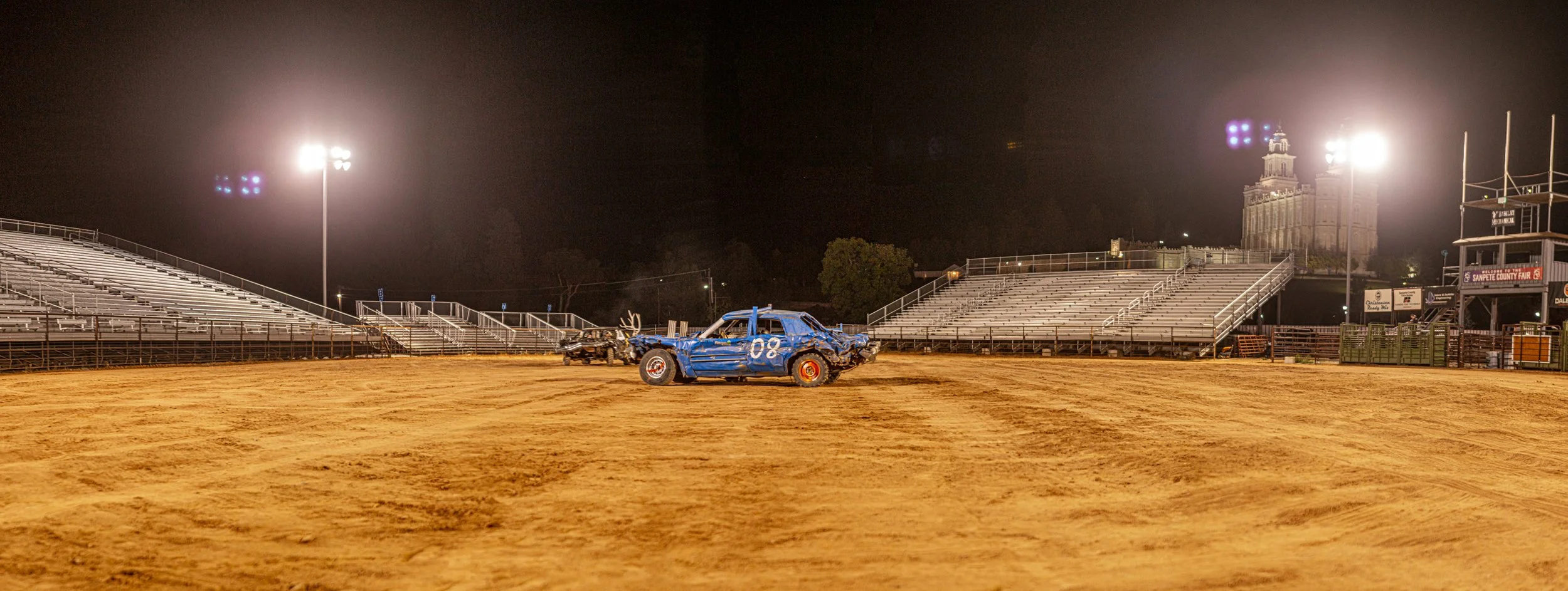
We could go on for hours about the challenges we faced with these vehicles, but one night in particular stands out. We were filming overnight in the freezing cold down in Sanpete County, Utah, on their demolition derby grounds—basically driving in circles with our actors behind the wheel. Not only were we all freezing, but these vehicles had no seats or cushions and had been stripped down to raw metal. So the actors were spinning donuts and holding on for dear life while sitting on freezing cold, sharp steel.
At one point in the middle of the night, one of the cars stopped working. The air felt heavy, and everyone was doing their best to stay positive while we tried to troubleshoot. One crew member suggested we check the gas—she said the sound it was making reminded her of when her own car runs out of fuel. The suggestion was made... and ignored. Until finally—yep. It was just out of gas.
On another day, our vintage police car stopped going into reverse. Not a huge problem—except we were filming a chase scene. We had a shot where the police car veers off the road onto the shoulder and stops just short of a river. The car only needed to drive about 30 feet forward, which was fine. But between takes, we had to reset the car by putting it in neutral and physically pushing it back into position—with several crew members doing the heavy lifting.
At the end of the day, every vehicle that showed up in the movie had a story. Our blue Jimmy derby car was literally picked out of the blue during a real demolition derby as our “hero” car—and by chance, it had the perfect sequence of hits in the arena that made the final cut of the film.
Our “Jimmy” truck felt like the perfect All-American, Midwestern pickup—one that matched Jimmy’s personality exactly. It also reflected his love for Everly, as it mirrored the red color she sported in most of her scenes. Everly’s Camaro seemed like the perfect fit for a wannabe rockstar with big dreams. It even had blue trim—a subtle reflection of her love for Jimmy, who wore that color throughout most of the movie.
-
Assemble Your Team (5-10 minutes)
Who would be the first 3-5 people you'd call in the event of an alien invasion?
What unique skills or qualities does each person bring to the team?
Assign roles based on strengths (Leader, Scout, Medic, etc.)
Resource Assessment (5-10 minutes)
List available resources (vehicles, supplies, safe locations)
Identify potential gathering points
Map out escape routes from your current location
Communication Protocol (5-10 minutes)
Establish primary and backup methods of contact
Create code words for different scenarios
Determine meetup locations and timing
Action Plan Implementation
Share your plan with your designated team
Create supply caches or emergency kits
Practice emergency meetups (optional but recommended!)
Pro-tip: If you need a little inspiration crack open and play “Good Alien, Bad Alien” the original Alien Country Survival Game, and learn what your closest friends and family really think about you!
Stories from Production
-
The lights came up, the projector faded, and Renny and I stood next to our composer Mike Bishop, and our producers, Charan and Gordon, in front of an Italian audience after our successful Trieste Science and Fiction Festival screening. As we waited for the translator to introduce us, the entire experience felt alien—but in a totally different way. Here we were, on foreign soil, surrounded by fans speaking a foreign language, and I was curious to hear the first question they’d ask about the film.
“Please explain what the heck was going on in that car-smashing sport thing you Yankees do.”
That’s not a direct translation, but it captured the spirit of the first question.
I grew up on the East Coast and had never seen a demolition derby in person. I’d only ever heard of them—a motorsport that probably sprang out of a testosterone-fueled fever dream where someone said, “What if bumper cars... but dangerous?”
It wasn’t just the Italians who asked about the derby—audiences everywhere were curious. And honestly, I remember the first time I ever saw one in person, in Spanish Fork, Utah. It was probably a decade before we filmed our own real demolition derby scene for Alien Country. The whole experience blew my mind. The scoring system was confusing, but the energy was unreal. My main takeaway? I wanted to be the first person to put a demolition derby in a major motion picture. In my mind, nothing was gonna capture the heart of the modern American West better than the bizarre motor bloodsport of destroying old steel against steel in a rodeo "Battle Arena."
Growing up, my dad shared with me a unique definition of "LUCK." Hanging—somewhat ironically—from the ceiling rafters of his high school wrestling room were the words: "Luck is when preparation meets opportunity." That idea has always stuck with me. Sometimes you're lucky, and sometimes things seem like a miracle. Whether it was luck or a miracle, how we managed to pull off the demolition derby scene that opens the film is perhaps the craziest story of our entire journey.
In 2015, we were still trying to raise money for Alien Country, so we coordinated with the Manti Demolition Derby to shoot promo footage for a teaser. We hired a drone team, mounted cameras inside cars, and filmed from the sidelines. But power lines interfered with the drone, the in-car camera was smashed mid-heat, and our sideline cam had a recording error that lost half its footage.
It was a mess—and it left me discouraged for a long time... years, actually.
But between 2015 and 2019, we kept sharpening our skills through YouTube and other projects. Then one summer, I reopened that footage—and realized we had captured some absolute gold.
I cut together a short video and posted it to the Manti Demolition Derby’s Facebook page. That same day, they sold over a thousand tickets. The organizers messaged us: “If you want to come back this year and film, you’re welcome to.”
We returned with the same spirit, more experience, and a shiny new arena.
I’d always pictured Jimmy in a blue truck and a red derby car. While scouting the gravel fairgrounds lot with my friend Skyler Brunner, he pointed out a bright blue car with the number 8 painted on the side. That’s when we met Brian Andersen, who became our demo-derby driving team lead for the next four years.
And the real magic—the kind you can’t plan for—happened at sunset, as that blue number 8 rolled into the arena…
A few days before the derby, I sketched out storyboards of the sequence I hoped to capture—knowing they were very specific to what was written in the script. But my thought was, we could always come back another day, or even a year later during full production, and re-stage the shots properly. So, what I told Brian was simple: Jimmy would go out into the arena, get a few good hits in, and then start getting absolutely pummeled—especially by Officer Kirk. Eventually, Jimmy gets pinned against the wall, and his car catches fire. He has to escape.
That was the vision, the dream. But I kid you not— pound for pound, that’s exactly what happened that day.
Brian started strong, landing a bunch of clean hits—one of which we caught in a spectacular drone shot. This time, we were operating with two drones: a traditional cinema drone and an FPV drone. (At the time, FPVs weren’t being used much in cinematic contexts—but again, preparation met opportunity.)
Then, right on cue, Brian was pinned against the wall and slammed by two cars. The only thing that didn’t match the script exactly? His car didn’t catch fire.
The other car did.
The one that crashed into him from behind burst into flames.
It was unreal.
I’ve included in this book the storyboards I drew before that day, alongside the real footage we captured—and it’s astonishing how closely they match.
We always considered the possibility that whatever we captured during the 2019 Manti Demolition Derby might make it into the final cut of the film. So, we shot it with that in mind. But we also assumed we’d come back the following year during production and properly stage the scene, shot for shot.
Then COVID hit.
All demolition derbies in 2020 were canceled. Which meant—like it or not—the footage we captured in 2019 was the only demolition derby footage we’d ever have with a live audience.
In 2020 and 2021, we returned to the fairgrounds two more times to fill in the gaps. We shot our actors performing behind the wheel, and reaction shots from the stands. In the end, what looks like a million-dollar sequence was created for closer to ten or twenty thousand—spread out over three years.
In indie film, if you want quality and don't have the money... you can always spend more "time." I guess you could say that's exactly what we did.
-
The original inspiration for the fictional town of Blue River came from the small, rugged towns of Green River and Hanksville, Utah. Renny and I spent a long time driving around the state, especially trying to find great locations closer to home in Salt Lake or Utah Valley. We were searching for something that captured the spirit of those desert towns—particularly a place that could serve as Nana’s farmhouse. When we found a picturesque home belonging to a family who’d been cattle ranching in Utah Valley for over 100 years—we knew we’d found our place. That’s when we officially settled on Spanish Fork as our central filming location.
There are a lot of practical considerations when choosing a location—one of the biggest being where your base camp will be. Ideally, you want a place you can stick with for at least a week. We had one main trailer that served as our wardrobe and makeup hub. As we quickly learned as first-time feature filmmakers, it’s way easier to move trailers over the weekend than overnight during the week.
Luckily, just down the road from the Nana’s home location, we found the perfect secondary location: a bar that had actually been featured in an episode of Yellowstone. Due to COVID restrictions, they were only open four days a week, which meant we were able to book out the Maple Mountain Bar & Grill for three and a half of our biggest production days during week one.
The bar’s manager, Jace, quickly became one of our earliest and easiest friendships during production. He even makes a cameo in the bar scene itself. A couple years later, I returned after post-production had wrapped, only to find the bar was no longer there. It was a bit of a bummer, but maybe not entirely surprising—the building had changed owners and permits more than once.
The evolution of that building went something like this: it started as a bar called The Tipsy Cow, became the Maple Mountain Bar & Grill, and now—believe it or not—it’s a kindergarten.
Which, in a weird way, kind of makes sense.
First, people get a little tipsy. That can lead to starting a family. And once the kids are big enough... well, they need somewhere to go to school.
Am I right? If we ever were to make a sequel to Alien Country it would be great to have Jimmy and Everly pick up their kid from school at that same location.
As an artist, I’ve filled sketchbooks, written down thousands of ideas, and started countless projects that never made it past the concept phase. That’s just part of the process. But for a film to get made, it needs that tipping point—that moment when enough people are invested in making it happen.
With Alien Country, that tipping point began when Charan joined us. He wasn’t just another collaborator—he was a catalyst. He brought fresh energy, ideas, and enthusiasm, and suddenly, the project felt real in a way it hadn’t before. It wasn’t just my film or Renny’s film anymore. It was our film. And when you reach that point—when your creative project has people behind it who need to see it happen—things start to move.
So, we dusted off the script, spent a couple of months rewriting it, and got a bunch of friends and family together for a table read.
We gathered a group of actors, found a cool barn venue, set up some moody lighting, and read through the first draft of Alien Country out loud.
I’d love to tell you it was a knockout success, that we knew right then and there we had a masterpiece on our hands. But the truth? Hearing the script out loud made us realize just how much work still needed to be done.
So we buckled down and got to work.
-
Originally, we envisioned Jimmy working at a mechanic shop attached to a gas station. But there wasn’t anything quite right near our base camp, so we improvised. One of the neighbors down the street let us use their home garage, and it ended up working great for what we needed.
Then we started looking for a barn where we could shoot the scene where Jimmy, Everly, and Sheriff Rogers go hunting for Kogg monsters. Again, luck struck. Just down the street from the garage location, we found a barn that already had about 70% of the set dressing we envisioned—old farm equipment, worn wood, and even a semi-circular church pew (okay... we didn't envision that specifically, but it was creepy and weird and therefore perfect). We tossed in a few hay bales and a meat hook, but for the most part, it was a found-location jackpot.
The barn day was wild. We shot on what's called a “split”—starting in the afternoon and going into the night. Inside, it was dusty, cramped, and probably full of rodent poop. After a few hours, everyone was coughing, which, in the middle of COVID, gave us all a little extra fear and trepidation. But hopefully, it all added to the mood of the scene.
-
The cornfield scene was one of the most challenging days of the entire production.
As a live-action filmmaker, you end up learning a lot of random stuff. So... first, a quick lesson in corn: there are a few types grown in the U.S.—sweet corn, which we eat on the cob; grain corn, which gets made into cornmeal; and cattle corn, which is grown on a schedule and harvested early to be fed to livestock. When we first scouted the Nana’s house, the owners had a huge cattle cornfield in their backyard. If we’d been filming just a few weeks earlier, we could’ve shot the scene right there.
But by the time cameras rolled, the entire field had been cut down.
So, the week before production, I drove around Spanish Fork trying to find a new cornfield that would still be standing during our shoot. The problem was weather. Grain corn is harvested right after the first frost. As soon as temperatures drop below freezing, the whole field can get cut the next morning. I’d ask farmers if we could film in their cornfields, and the answer was usually something like: “Sure… unless we cut it down before you get here.” Which was, of course, NOT super reassuring.
Eventually, we found a great field just down the road from the rest of our filming locations. We even had a couple of corn mazes on standby in case winter showed up early.
But the shoot day itself? Um… yeeeeah…
In a typical production, you try to cover about three to four minutes of screen time per day. Roughly one page of screenplay equals one minute of screen time, so a producer will say something like we are trying to shoot 3-4 pages today. Well-funded films will shoot less, and indie films on a shoestring budget will try to cover more. How much you can actually get done depends on how complex the shots and sequences are—if you’ve got more than three or four characters, stunts, visual effects, or tricky lighting setups, things can slow down fast.
So what did we do?
We tried to shoot nine pages—at night, in a cornfield—with fog, drones, a crane, stunts, creatures, eight actors, and dozens of visual effects shots. Because, of course we did.
I spent the morning rewriting and rewriting my shot list, trying to make the day achievable. But we knew going in it was going to be tight. From sunset on, we were racing the clock.
We pumped fog into the field to create that surreal horror vibe, but with the wind constantly shifting, our special effects team had to keep moving back and forth all night long, dragging huge tubing through rows of corn to keep the fog looking consistent.
About two-thirds of the way through the night, I started to realize we might not get everything we needed.
But then came the moment.
SPOILER ALERT: When Sheriff Rogers is attacked and has his death scene—whether it was the stress, the exhaustion, or just the sheer brilliance of the cast—it completely took my breath away. KC, Sila, and Trey absolutely nailed it. The emotion, the tension... I even got a little misty-eyed. That scene is still one of the most memorable directing experiences of the entire production.
While we managed to capture some great material during the original cornfield shoot, it became clear in post-production that we were still missing a few key shots. So, one year later in 2021, we returned to Spanish Fork—this time to a nearby corn maze.
We used the opportunity to get extra coverage of Renny’s character, including a little homage to Alien 3, some insert shots like the flashlight getting crushed by the creature’s leg, and a few more action beats with Sheriff Rogers running through the stalks.
During principal photography, I even got to make a brief cameo. In the overhead crane shot of Sheriff Rogers being chased, the “creature” was really just a glowing tube of light held by Max Turek from our G&E team—while I ran ahead with a flashlight, trying not to trip over myself in the dark. Which as luck would have it, we totally did.


-
The Frostop was both a cultural and personal part of the story for Renny and me. Renny’s great-grandparents owned and operated a Frostop in Southern Utah back in the 1950s and ’60s. While we were writing Alien Country, we found some old photographs taken with a stereoscopic camera—vintage images of root beer floats and towering ice cream sundaes. Those snapshots of classic Americana became a touchstone for us, an iconic piece of small-town Western life that we knew we wanted to capture on screen.
Those vintage photographs echoed another memory for me. While I was in film school, I worked as a gaffer on one of my first student productions. The shoot took place at a little ice cream stand called Ripples. That was back in 2008. Twelve years later, that same small-town treasure—Ripples—became one of the shooting locations for our very first feature film.
We always aimed to make Blue River feel "timeless"—at least from my perspective. Showcasing Americana frozen in time (and/or custard) just felt right.
-
Renny and I have now visited Goblin Valley more times than I can probably even count. It’s about three and a half hours from our house in the Salt Lake Valley, but over the years we’ve gone there on vacation or as part of various film productions.
For our YouTube channel, we shot a funny Halo parody short, which was basically just Renny, myself, and a friend dressed up like a Halo Spartan running around in Goblin Valley.
While we were writing the script, another fantastic suggestion from Sergio Paez was to have our characters cross over into Alien Country through a surreal desert landscape—and we knew we had to utilize one of the spectacular, otherworldly places in our backyard.
With some brilliant production design by Ralph Wulfsohn, including battery-powered glowing green rocks, we transformed the already bizarre landscape of Goblin Valley into a truly extraterrestrial world.
We shot there for one day during principal photography, then came back a year later with a body double for KC Clyde and filmed a number of aerial shots to fill out the sequence. With a little creature VFX magic, we built out a fantastic alien world.
Within a couple days of filming with our cast and crew among the Goblins, I cracked open the edit timeline and threw together the quick scene where Jimmy and Everly leave the fairgrounds, step through the portal, and we cut to "Alien Country". We hadn’t even added visual effects yet, but we showed it to a few members of our crew—and in that moment, we all knew we had something.
-
Canyon Country
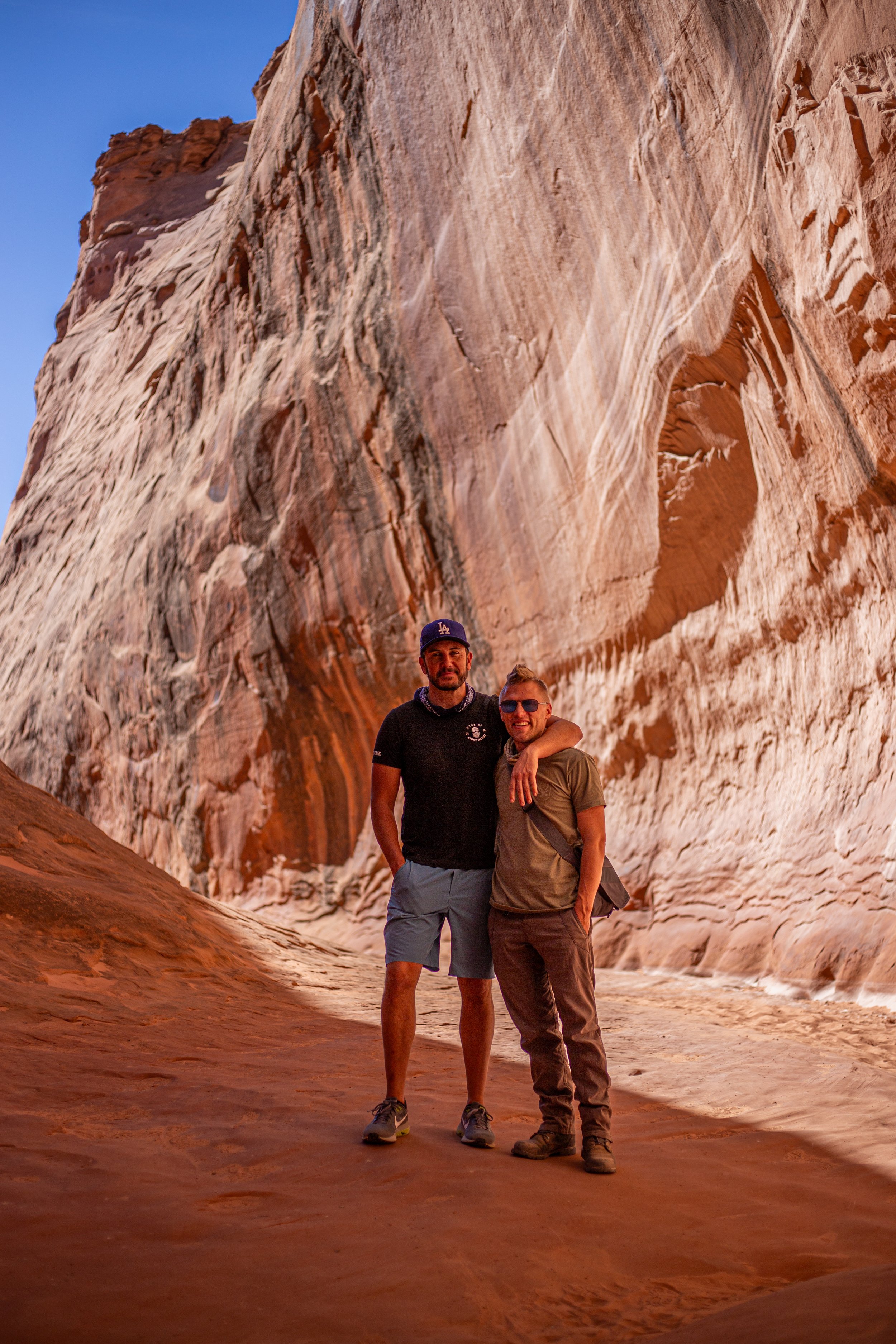
Early in 2010, I was introduced to a wild and wonderful sport called canyoneering—a kind of technical mountaineering in reverse. It involves navigating sandstone slot canyons throughout Utah and the Southwest that have been carved out over millions of years by wind and water. The towering orange and red walls, sometimes hundreds of feet high and sometimes only inches apart, create otherworldly corridors and formations. It doesn’t take much to feel like you’ve stepped onto another planet. From the very first time I stepped into the slot, I knew I wanted to capture that experience and put it on the big screen.
My roommate Josh invited me on that first canyoneering trip, and not long after, it became one of Renny and my go-to weekend getaways.
We fell in love in the desert. One of our first trips as a couple was canyoneering in a canyon we would eventually film part of Alien Country in. We camped, hiked, and drove endless miles of dusty desert roads, daydreaming about our future movie. We’d pass by old gas stations or rundown towns and say, “This would be perfect for that one scene...” Some of those casual observations turned out to be spot on.
In fact, we once stayed in a hotel in Southern Utah that was literally down the road from BLM land with an abandoned mining site. That same stretch of land ended up being a key filming location, and just a short drive away was "the slot canyon"—the place where we’d shoot one of our most epic chase scenes.
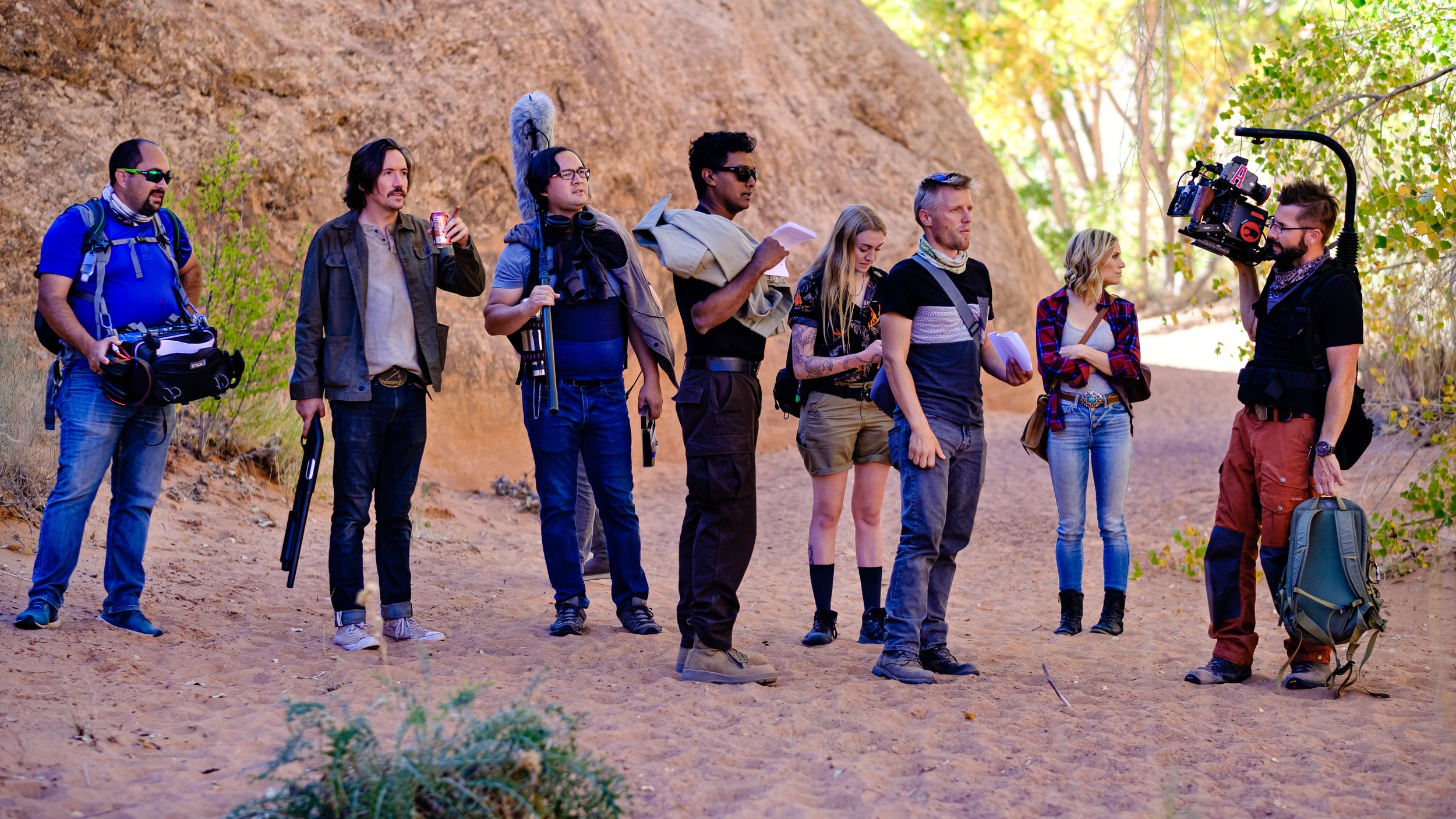
Filming in that canyon ended up being a bit of a miracle. During preproduction, we had settled on filming a chase sequence in a different canyon accessible by ATV—which would have made crew and gear transport a lot easier. I remember telling our 1st AD, Aspen Andrews, that my dream was to show the team the canyon that inspired the film. I described my first rappel and scuttle through it, and how much it would mean to let everyone experience the setting firsthand. Renny and Aspen looked at me and said, “You want us to go hiking... and then go shoot a movie?”
“Well, when you put it that way...”
But as luck would have it, we wrapped our second week of shooting with a night in Goblin Valley and had two days off in Southern Utah. Midday, Renny and I took a few cast members on a hike—and by pure chance, we passed Wes Johnson, our cinematographer, already on the road. We told him where we were headed, and the next the we knew the cast and crew spent the day hiking through the canyon!
Later that evening, we brought Wes to the other film location where we had planned to shoot. After walking through it, he turned to us and said, “If you want to capture something sacred, something cinematic—you’re not going to find anything more special than that slot canyon.”
Several phone calls and some last-minute permits later, we made the switch. We shot both the alien canyon chase and Jimmy’s astral projection sequence in that magic canyon.
Sometimes, if you make space... the universe really does unlock the path.Item description





-
The idea to set our final battle in the same arena where Jimmy loses everything came from Sergio Paez. We were brainstorming more cost-effective locations for our climax—we considered them fighting aliens in a carnival or facing them down in an industrial mining site. It made more sense from a character and story perspective to have them face the creatures back at the fairgrounds, where things first spun out of control. But from a budget perspective... I guess I was riding a little high after the miracle that happened at the 2019 demolition derby. Only because of that did we have the confidence (maybe even a little overconfidence) to go big in the end.
The one thing I wish we could have done differently? I wanted to film that final battle at night, with the stadium lights off. That would’ve let us be more selective with what was seen on camera and saved money on visual effects. But the cost of rigging moonlight-style lighting for an entire arena was well beyond our budget.
So instead, we embraced the harsh stadium floodlights. That meant you could see everything—which also meant I spent about five months meticulously cutting, rotoscoping, and compositing over 110 VFX shots for that sequence.
Our creature team did a phenomenal job animating the monsters. Did it hit ILM standards? Maybe not. But we’ve got a bunch of small-town yahoos running over aliens in demolition derby cars. If you've made it to that point in the movie, you're probably already on board—and maybe even cheering.
In several wide shots, Brian Andersen and other demolition derby drivers were behind the wheel. But for select setups, our actors—KC Clyde, Dominique Noelle, and Trey Warner, and their respective shotgun riders Charan, Rachele, and Corbin—got the chance to climb in and rally those same derby vehicles themselves, whipping around the arena in full costume. I sort of wish I had known this before, but Corbin let me know afterward that there was literally a hole in the floor of his car during the shoot.
And of course, to tie everything together, we added one more day on a green screen stage. That’s where we captured tight shots, punchy one-liners, and some over-the-top reactions to help sell the sequence. It brought just the right blend of chaos and comedy to complete what we now call the "Extraterrestrial Rodeo."
-
Filmmaking is expensive. Tech can get more and more affordable, but at the end of the day, this art form ain't cheap. And like I’ve said before, if you don’t have the money, you can always spend more time.
There was one set of scenes where Everly had fallen into a cave on the alien planet, and even thought there was a great spot for it, we didn’t quite have enough time to get the shot at Goblin Valley. So, we turned to another familiar location: the lava tubes in Fillmore, Utah, where we had once filmed a YouTube video that never got finished.
Now, our last proper day of production was actually on a process trailer. For those unfamiliar, that’s where you lift a vehicle—in this case, Jimmy’s truck—onto a trailer and film all the driving scenes while towing it down the road. We shot those scenes over the course of one afternoon and evening.
The next day, we had our wrap party. Everyone had a great time. But since it was the weekend, we still had access to our fancy Hawk V-Lite Anamorphic Lenses—the super posh ones we’d only been able to use because of COVID-related availability. And I’ll be damned if we weren’t going to squeeze every last drop of value from our limited budget.
So, in the middle of the first snowstorm of the year, Renny, myself, our 1st AC Nic Edwards, our gaffer Skyler, and Joseph Reidhead (who played Gus and kindly filled in as our boom op) all drove two and a half hours south to Fillmore, Utah, to film one last scene for the feature.
It wasn’t until we got back, packed up the gear, and shipped off those lenses the next day that I really felt like we had wrapped "principal photography".Item description
-
As filmmakers working Utah, there are countless sites and wonders we discovered. It all started with planning the trip, filling up the gas tank and just going! So, it’s time to up the stakes:
If aliens were invading tomorrow and you might not survive, what incredible places in would you wish you'd explored? What adventures would you regret not trying?
Don't create an endless bucket list. Pick just 3 adventures and commit to actual dates to do them.
Write your choices below:
Adventure 1: Location: Date:
Adventure 2: Location: Date:
Adventure 3: Location: Date:
Pro tip: Sometimes the most spectacular locations and life-changing experiences are right in your backyard. But sometimes they might take you to the other side of the planet, but if this really was the end of the world, what 3 things you would want to do? Why are you not doing them?
A Brief History of Extraterrestrials in America
-
While Alien Country spins its own unique tale of extraterrestrial encounters in small-town Utah, it draws inspiration from America's deep history of UFO sightings and alien encounters. Our fictional town of Blue River might seem far-fetched, but the truth is, the American Southwest has been a hotbed of unexplained phenomena for decades. From mysterious government facilities to strange lights in the desert sky, real-world events helped shape the cultural backdrop against which our story unfolds. Here are some of the most significant UFO encounters in American history that influenced the atmosphere and mythology of Alien Country:
-
The first time I heard about Roswell, I was in elementary school. Area 51 is probably the most publicly known “secret” in American history. So let’s break it down real quick.
Picture this: It’s a scorching July night in New Mexico, and Mac Brazel’s sheep won’t stop bleating at something scattered across his ranch. What he found wasn’t any weather balloon, folks—we’re talking strange metallic debris that didn’t bend, otherworldly symbols, and, according to whispered accounts, bodies that weren’t quite human. The military swooped in faster than a desert dust devil, changed their story three times, and left us with one of America’s greatest UFO mysteries. The truth? It’s still out there, buried somewhere in the New Mexico sand.
-
When researching Alien Country, we encountered two main types of stories: UFO sightings and abductions. This is one of the most well-documented cases of the latter.
On a starlit night in New Hampshire, Betty and Barney Hill were just two ordinary people taking a drive—until a bright light started tailing their '57 Chevy. Then, two hours of missing time. When they came to, they had mysterious star maps in their memories, recurring nightmares, and a terrifying story of medical experiments conducted by strange beings. Their case became the first widely documented alien abduction story in the U.S., reading more like a horror novel—except they lived it.
-
March 13, 1997—the night Phoenix, Arizona, got its own cosmic light show. Massive, silent, V-shaped formations of lights cruised over the city like they owned the place. Thousands of people saw it—including the governor, who initially mocked the sightings before later admitting he had been a witness himself.
Military flares, they said. But ask anyone who was there—flares don’t move in perfect formation, or span the width of the valley. The Phoenix Lights turned skeptics into believers and became one of the most famous mass UFO sightings in American history.
As Renny and I wrote about UFOs in Alien Country, we spoke with experts who ran one of the largest online communities for sightings. They had witnessed multiple phenomena in Arizona. Their belief? That UFOs aren’t ships, nor necessarily visitors from another planet. Instead, they saw them as fourth-dimensional beings, capable of transcending space and time. When they appear in our dimension, we perceive them only as glowing orbs of energy. They also suggested that early indigenous inhabitants of North America likely saw the same phenomena, leaving behind clues in their petroglyphs. One researcher even told us he had been working to establish connections between ancient symbols found throughout the West and modern UFO sightings. You can see echoes of this conversation in the film—like when James Walker first discovered the portal stone in an ancient pueblo burial site—or in the deleted scene, The Prophecy.
-
Deep in Utah’s west desert, far from the spotlight of Area 51, sits the Dugway Proving Ground—nicknamed Area 52 by those who know where to look. Officially, this massive facility, larger than the state of Rhode Island, is used for biological and chemical weapons testing. But locals tell a different story.
They speak of strange lights dancing across the desert sky, geometric shapes appearing and vanishing, and mysterious aircraft that move like nothing built on Earth. Unlike its Nevada cousin, Area 52 keeps its secrets buried deep in Utah’s red soil, where the line between military testing and something much more extraordinary blurs like a heat wave on the desert horizon.
This area was literally the birthplace of Alien Country. Like I mentioned in a previous section, I was out filming a short at a gas station near a place called Skull Valley—just north of the Dugway Proving Ground. The real-life tales of the unknown from this place are the reason our movie exists.
-
Releasing Alien Country Into the Beyond: ****What. A. Feat. Within a two-week span, we screened Alien Country six times in five cities and three countries.
After four long years, it was finally time. The international world premiere took place at the Flickers Rhode Island International Film Festival—a 42-year-old, Oscar-qualifying event in the heart of Providence. We went, we networked, we watched movies, we made friends… and we threw our own party! We brought our own step-and-repeat, managed to mooch a red carpet off the fabulous festival PR team, and created our own hype around the screening. Just like every other part of the process, there were bumps in the road—and this final leap was no different.
When we arrived, our screening schedule was different from what had been emailed. That meant scrambling to confirm the new time, working with the festival projectionist to make sure our DCP was functioning properly, and figuring it all out while friends and family were flying in to see the film. After two long days of uncertainty, we finally locked in a new screening time with a working DCP.
At the final awards ceremony, we were floored to be honored with the Grand Prize for Best Comedy Feature Film.
Then came the local theatrical premiere in Utah.
This one was a doozy. We rented the biggest theater we could find—conveniently just down the road—and threw an after party at the Ninja Kidz gym (owned by famous YouTuber Payton Delu, who plays Elsa in the film).
We glammed up. We had a VIP lounge with actors signing posters. We laid down our own red carpet and step-and-repeat, took a gazillion photos with friends, family, and fans, and sold out a 500-seat theater.
As the credits rolled, Boston ran out to grab the hard drive with the DCP to pass to KC Clyde, who had a flight to LA that night to deliver it in person for our next screening.
Two days later, we were in St. George, Utah, winning another award at HorrorFest. That one was extra special because two of our actors are from there, and we had previously screened the first 20 minutes of the film as a test several years earlier. Fans came up to us afterward saying, "We saw the beginning two years ago—we’re so glad we finally got to see how it ends."
The following Monday, we flew to LA. We landed, took a phone interview in the parking lot of a Target, tested the DCP, set up the red carpet and step-and-repeat, then glammed up to party all over again. This time, press arrived, and we did the full red carpet experience with interviews and photos alongside our LA cast and crew. The screening was electric and ended with an incredible talkback session. We got home to our friend’s Airbnb, slept two hours, and then flew back home.
That weekend, we were off again—this time to Venice, Italy.
It should’ve been smooth sailing, except... Boston realized his passport had expired. So, while I held down the fort (including doing a TV interview with star Rachele Brooke Smith), Boston flew last-minute to Denver and miraculously expedited a passport in under 24 hours.
We had a couple of days in Venice to “celebrate” our 10th wedding anniversary (not actually until November, but how were we ever going to top Venice?) before we stepped onto the red carpet at the Trieste Science+Fiction Festival—the largest sci-fi film festival in the world. We were greeted by the festival director like old friends, raving in a British accent: “Boston and Renny, I LOVE your movie!”
One of our executive producers even joined us in Italy and got to share the film with his extended family just two hours away.
Finally, we flew to London, where Alien Country screened twice at the Odeon Luxe in Leicester Square at FrightFest—the largest horror fest in the world. It was the same theater James Cameron built to test screen his movies, and the whole thing felt surreal.
During the course of our worldwide tour, Alien Country was released on all major platforms, including Amazon and Apple. It was even featured in the New York Times and Film Threat, which wrote:
“Alien Country is the film that Cowboys and Aliens wishes it was. No offense to Daniel Craig, Olivia Wilde, Harrison Ford, or Jon Favreau, but this is a better movie. It punches far above its weight with a solid story, comedic dialogue, exciting action, and relatable characters. It’s just more fun. One could easily imagine a sequel.”
Flying home from London, those whirlwind weeks felt like a dream.
As Ben says in the movie, we felt "like [we] just opened a vortex beyond space and time." And as Jimmy and Everly said, “We did it.”
“Yeah… we really did it.”
-
That's right! It's time. If you haven't done it already here is your mission:
Call up your favorite humans and invite them to have a full on alien country party. We've done the hard work for you already, below in this guide is a list of incredible out of this world recipes for foods you can cook, and when it comes to the entertainment, obviously you've got the movie, you've got the card game, you even got a suggestion of a bunch of fun activities you can do right here in this book.
Step #1 - Call your humans, and set a date.
Step #2 - Pick a venue, obviously some of the activities in this book could be done at home, while others require you going out under a starlight sky. Camping trip, house party or theater invasion, it’s up to you!
Step #3 - THROW YOUR ALIEN COUNTRY PARTY! Tag us @aliencountry on social and let us know how your party went down!
Alien Country Nachos 🌌🛸🤠
Blend the best of alien-inspired creativity with bold, hearty flavors of the American West for a dish that’s as wild as it is out of this world! These nachos bring the farm-to-galaxy experience with smoky meats, zesty sauces, and cowboy-approved toppings.
-
Chips and Base:
1 bag of blue corn tortilla chips (alien skies)
1 cup crispy fried wonton strips (to mimic tumbleweeds)
Alien Guacamole:
2 ripe avocados
Juice of 1 lime
1 clove garlic, minced
1 jalapeño, diced (optional)
¼ cup cilantro, chopped
½ tsp smoked paprika (a smoky, Western twist)
Salt to taste
Galactic Western Toppings:
1 cup shredded pepper jack or smoked cheddar cheese
½ cup slow-cooked pulled pork or smoked brisket
½ cup black beans (space rocks)
½ cup roasted sweet corn (fire-roasted for that campfire feel)
½ cup diced tomatoes (red "planets")
¼ cup diced red onion (optional, for a sharp Western kick)
2 tbsp pickled jalapeños
2 tbsp crispy bacon bits (cowboy-approved!)
2 tbsp sliced black olives (mini UFOs)
UFO Glow Sauce:
½ cup sour cream or plain Greek yogurt
2 tbsp lime juice
1 tbsp honey
1 tsp matcha powder (glowing green)
1 tsp chipotle hot sauce (for smoky heat)
Extras (optional):
Salsa verde
Hot sauce of your choice
Chopped scallions or cilantro for garnish
Crushed tortilla strips for added crunch
-
Prepare the Alien Guacamole:
Mash the avocados in a bowl.
Mix in lime juice, garlic, jalapeño, cilantro, smoked paprika, and salt. Set aside.
Make the UFO Glow Sauce:
In a small bowl, whisk together sour cream, lime juice, honey, matcha powder, and chipotle hot sauce until smooth. Set aside.
Assemble the Nachos:
Preheat your oven to 375°F (190°C).
Spread blue corn tortilla chips and crispy wonton strips on a large baking tray or oven-safe dish.
Sprinkle cheese evenly over the chips.
Layer pulled pork or brisket, black beans, roasted sweet corn, tomatoes, red onion, and bacon bits.
Add pickled jalapeños and black olives on top.
Bake in the oven for 7-10 minutes, or until the cheese is melted and bubbly.
Add Western-Alien Elements:
Remove the nachos from the oven and top with dollops of Alien Guacamole.
Drizzle the UFO Glow Sauce generously across the top, creating a mix of cosmic and ranch vibes.
Sprinkle with scallions, cilantro, or crushed tortilla strips for added flavor and crunch.
Serve:
Serve immediately with salsa verde, extra hot sauce, and maybe a side of cowboy chili for dipping.
Pair these nachos with a cold glass of sarsaparilla or a galaxy-blue margarita for a true Alien Country experience!
Galactic Onion Rings 🌌🛸🧅
Take your taste buds on an interstellar journey with these Alien & UFO-inspired onion rings! These crispy, colorful rings have a celestial twist, with vibrant dipping sauces that are as eye-catching as they are delicious.
-
2 large yellow or white onions (cut into ½-inch thick rings)
1½ cups all-purpose flour
1 tsp baking powder
1 tsp salt
½ tsp garlic powder
½ tsp smoked paprika (for a cosmic kick)
¾ cup buttermilk (or regular milk with 1 tsp vinegar or lemon juice)
1 egg
1½ cups panko breadcrumbs
½ cup crushed veggie chips or blue tortilla chips (for a colorful, alien-like coating)
Oil for frying (canola or vegetable oil)
-
Glow-in-the-Dark Dipping Sauces:
Cosmic Green Sauce:
½ cup mayonnaise or plain Greek yogurt
2 tbsp lime juice
1 tsp matcha powder
1 tbsp honey
Supernova Sauce (Spicy Red):
½ cup ketchup
1 tbsp sriracha or chili garlic sauce
1 tsp smoked paprika
½ tsp apple cider vinegar
Stellar Blue Ranch:
½ cup ranch dressing
A few drops of natural blue food coloring or butterfly pea flower powder
-
Onion Rings:
Prep the Onions:
Peel and slice the onions into thick rings. Separate the rings and set aside.
Make the Batter:
In a bowl, mix the flour, baking powder, salt, garlic powder, and smoked paprika.
In a separate bowl, whisk together the buttermilk and egg.
Prepare the Coating:
Combine the panko breadcrumbs and crushed veggie chips in a shallow dish.
Coat the Rings:
Dip each onion ring into the flour mixture, then into the buttermilk mixture, and finally into the panko-veg chip mixture. Press gently to adhere the coating.
Fry the Rings:
Heat oil in a deep pan or fryer to 375°F (190°C). Fry the onion rings in batches for 2-3 minutes or until golden brown and crispy.
Remove and place on a paper towel-lined plate to drain excess oil.
Dipping Sauces:
Cosmic Green Sauce: Mix all ingredients until smooth. Adjust lime and honey to taste.
Supernova Sauce: Whisk together the ketchup, sriracha, smoked paprika, and vinegar.
Stellar Blue Ranch: Stir ranch dressing with blue coloring until evenly mixed.
Assembly & Serving:
Arrange onion rings in a spiral or stacked UFO-like pattern.
Serve with the vibrant dipping sauces in small bowls for a galactic spread.
Optional: Garnish with edible glitter or sprinkle some crushed veggie chips on top for a final cosmic touch.
Enjoy these interstellar onion rings while stargazing or hosting a UFO-themed gathering! 🛸✨
Cosmic Chocolate Chip Cookies 🌌🍪👽
These out-of-this-world cookies bring an alien twist to a classic treat, featuring vibrant colors, galactic flavors, and a few interstellar surprises! Perfect for UFO-themed parties or a sweet galactic adventure.
-
Cookie Dough:
2½ cups all-purpose flour
1 tsp baking soda
½ tsp salt
1 cup unsalted butter (softened)
1 cup packed brown sugar
½ cup granulated sugar
2 large eggs
2 tsp vanilla extract
Green and blue food coloring (gel preferred)
1½ cups semi-sweet chocolate chips
½ cup white chocolate chips
¼ cup crushed freeze-dried raspberries (optional, for "cosmic dust")
Alien Add-Ins (Optional):
½ cup mini marshmallows (for "alien goo")
¼ cup edible glitter or shimmering sugar (for "stardust")
-
1 cup powdered sugar
1-2 tbsp milk or water
1 tsp vanilla extract
Neon food coloring (green, purple, or blue)
Edible star sprinkles or edible glitter
-
Instructions
Prepare the Dough:
In a medium bowl, whisk together the flour, baking soda, and salt.
In a large bowl, beat the butter, brown sugar, and granulated sugar until fluffy.
Add the eggs one at a time, mixing well after each addition. Stir in vanilla extract.
Add Cosmic Colors:
Divide the dough into two or three portions.
Add green food coloring to one portion and blue to another. Leave one portion uncolored if desired.
Gently swirl the colored doughs together to create a galaxy effect (do not overmix).
Add Mix-Ins:
Fold in semi-sweet chocolate chips, white chocolate chips, and freeze-dried raspberries.
If using mini marshmallows or edible glitter, fold them in now.
Shape and Chill:
Scoop the dough into 2-tablespoon-sized balls and place them on a parchment-lined baking sheet.
Chill in the refrigerator for 30 minutes (important for vibrant swirls and even baking).
Bake:
Preheat the oven to 350°F (175°C).
Bake the cookies for 10-12 minutes or until edges are lightly golden. The centers will look slightly underbaked but will set as they cool.
Let cool on the baking sheet for 5 minutes, then transfer to a wire rack.
Optional UFO Glow Glaze:
Mix powdered sugar, milk, and vanilla until smooth.
Divide the glaze and tint each portion with neon food coloring.
Drizzle over cooled cookies in UFO-inspired patterns. Top with edible star sprinkles or glitter.
Serving Ideas:
Serve these cookies with a glass of green "alien milk" (use a drop of green food coloring in milk).
Arrange them in concentric circles to mimic a UFO landing zone.
Enjoy these galactic cookies, perfect for fueling interstellar adventures! 🌠👾
Martian Sunset Mocktail 🌅🛸🤠
This alien-inspired Western mocktail blends bold, earthy flavors with vibrant cosmic colors to create a drink that's as dazzling as a UFO in the desert sky. Perfect for a space cowboy gathering or a UFO-themed celebration!
-
Base Layers:
½ cup fresh orange juice (for a "sunset" hue)
¼ cup cranberry juice (for deep red Martian vibes)
½ cup sparkling water or ginger beer (for effervescence)
1 tbsp agave syrup or honey (optional, for sweetness)
Alien Glow:
2 tbsp blue spirulina water
Ice cubes with edible glitter or small herbs like mint leaves
Garnishes:
Lime wheel or wedge
Fresh rosemary sprig ("alien antenna")
Edible star sprinkles or a pinch of edible glitter
-
1 cup powdered sugar
1-2 tbsp milk or water
1 tsp vanilla extract
Neon food coloring (green, purple, or blue)
Edible star sprinkles or edible glitter
-
Prepare the Alien Glow Layer:
If using blue spirulina, dissolve it in a small amount of water.
Assemble the Mocktail:
Fill a tall glass with glitter ice cubes.
Add orange juice to fill about half the glass.
Slowly pour in cranberry juice to create a layered effect.
Top with sparkling water or ginger beer for a fizzy "galactic atmosphere."
Add the Alien Glow:
Gently drizzle the blue spirulina water. Watch as it swirls, creating a cosmic blend of colors.
Garnish:
Add a lime wheel to the rim and tuck a rosemary sprig into the glass.
Sprinkle edible glitter or star sprinkles on top for extra sparkle.
Serving Tips:
Serve with a metal straw or a neon-colored reusable straw to enhance the sci-fi vibe.
Pair with Cosmic Pickled Veggies or Alien Country Nachos for a complete themed snack-and-sip experience.
Enjoy this Martian Sunset Mocktail under the stars or around a campfire, feeling like a true space cowboy! 🌌🤠✨
*To make into a cockail add tequila for a smoky flavor, Vodka for a more neutral flavor or Gin to enhance the floral or citrus flavors.